
I’ve always believed that some landscapes are too vast for a ceiling to contain, and AlUla is the ultimate proof. Standing here, with my boots sinking into the ancient orange sands of northwest Saudi Arabia, I take in the wide Arabian sky, and the desert is no longer just a backdrop- it’s a living, breathing stage where the wind, the shifting shadows, and the glowing sunsets are as much a part of the masterpiece as the sculptures themselves.
Returning for its fourth edition from 16 January to 28 February 2026, Desert X AlUla is stripping art of its traditional “white box” constraints and letting it breathe in the wild. As the region’s first public art biennale, the exhibition stretches across Wadi AlFann, AlUla’s rising hub for monumental land art. Guided by co-curators Wejdan Reda and Zoé Whitley, alongside Artistic Directors Neville Wakefield and Raneem Farsi, the 2026 edition transforms the landscape into a living exhibition – where every step feels like part of the artwork.
The guiding concept this year draws inspiration from the legendary Lebanese-American writer Kahlil Gibran, who once beautifully described dreams as “Space Without Measure.” It’s a poetic lens through which to view the desert, a place where horizons stretch into infinity and the sky feels close enough to touch. This theme invites both artists and visitors to shed their physical boundaries and explore the measureless realms of memory, light, shadow, and the boundless human spirit.
The Visionaries: 11 Stories Written in the Sand of AlUla
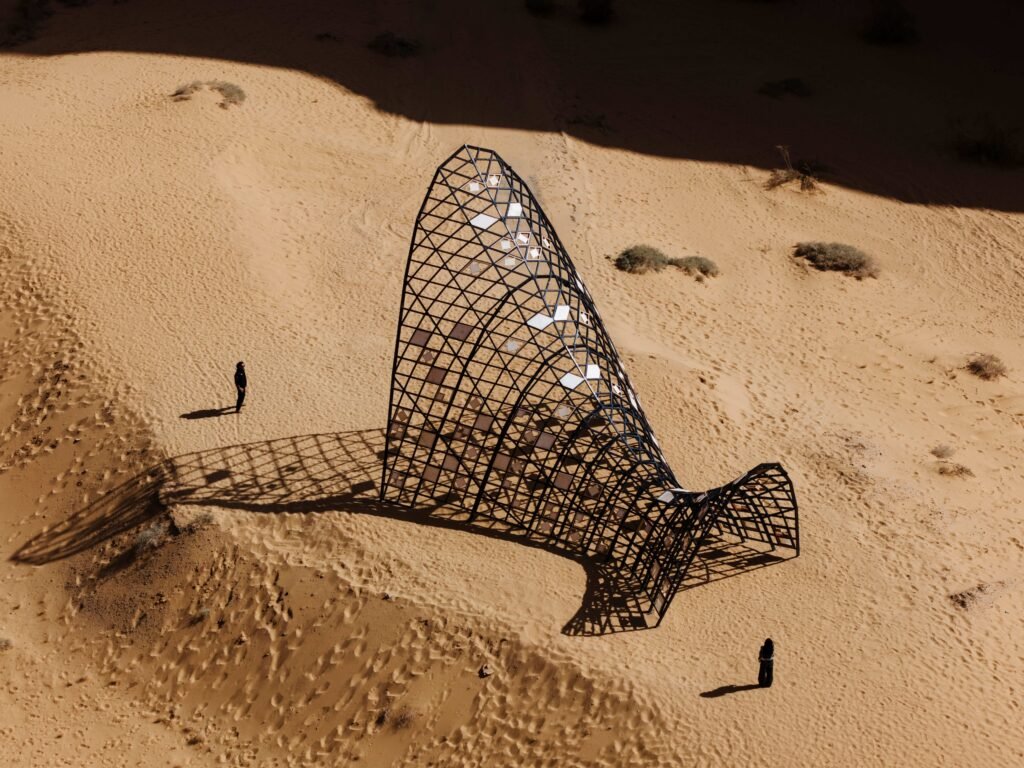
The very first art we came across was by Mexican-born artist Hector Zamora, his artwork aptly named Tar HyPar, turns the valley itself into an instrument, becoming the desert’s heartbeat. Inspired by traditional Saudi drums or ‘tar’ and hyperbolic paraboloid architectural forms, shortened to ‘hypar’, the installation transforms the valley into a playable instrument. The artist comments, “The paradox is the sonic environment amplifies our perception of silence, a humbling reminder of our place in the universe.”
It was an especially fun moment when the drummers started a tune and people joined in, singing, dancing, vibing. We watched as the valleys, often associated with silence, became alive with echoes of music, a reminder that art is not just something to simply observe, but something to experience together.
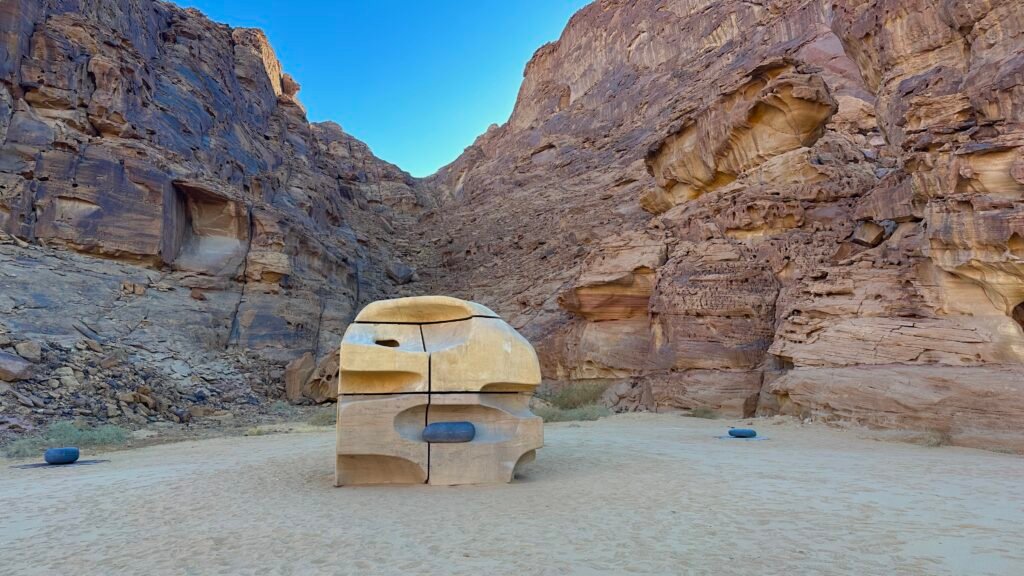
On the other side Murmur of the Pebbles by Saudi artist Basmah Felemban focuses on the tiny stones we usually crunch under our boots without a second thought. She has enlarged these microscopic details into massive limestone carvings, telling us to acknowledge the millions of years of erosion and history contained within a single stone. She thoughtfully observes, “The pebbles carry the knowledge of our ancient rivers. The pebbles carry the waves with them.”
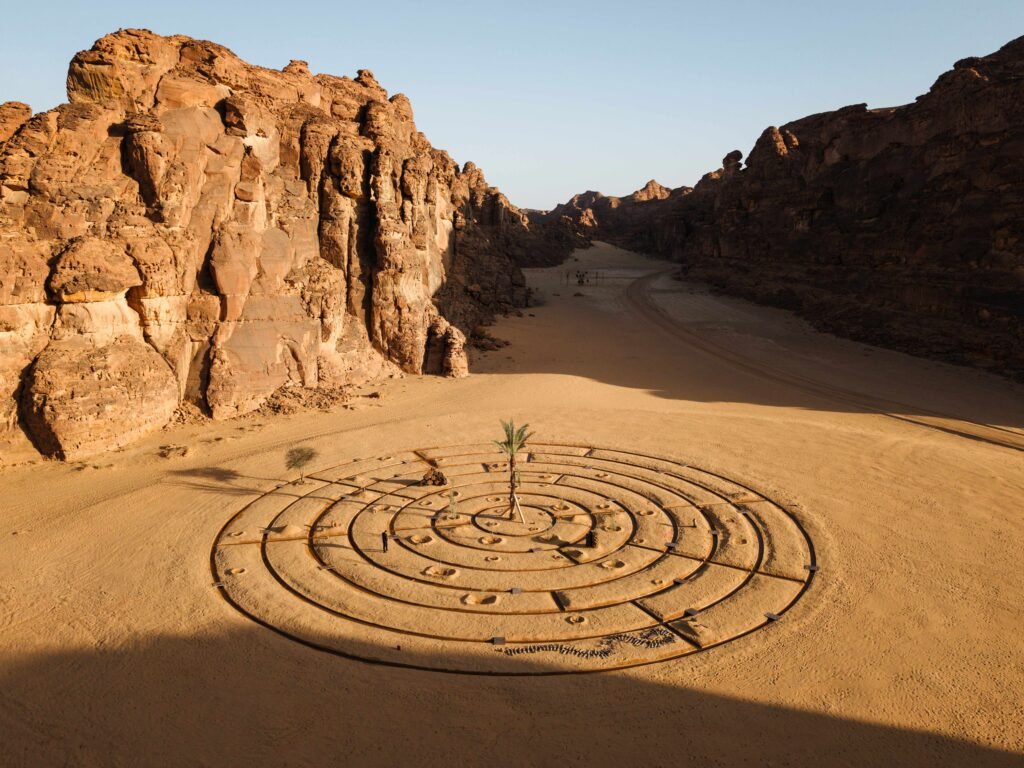
Across this, Saudi artist Mohammad Alfaraj reflects on the agricultural heritage of Al Ahsa. He has constructed a beautiful living labyrinth, an art, named ‘What was the Question Again?’, tells us how harmony naturally exists in the environment, and co-dependency is a crucial part of survival. Stories of the land and the people who tend to it are woven together in a physical maze of greenery and shade, at the center of which is a palm structure created from grafted trunks.
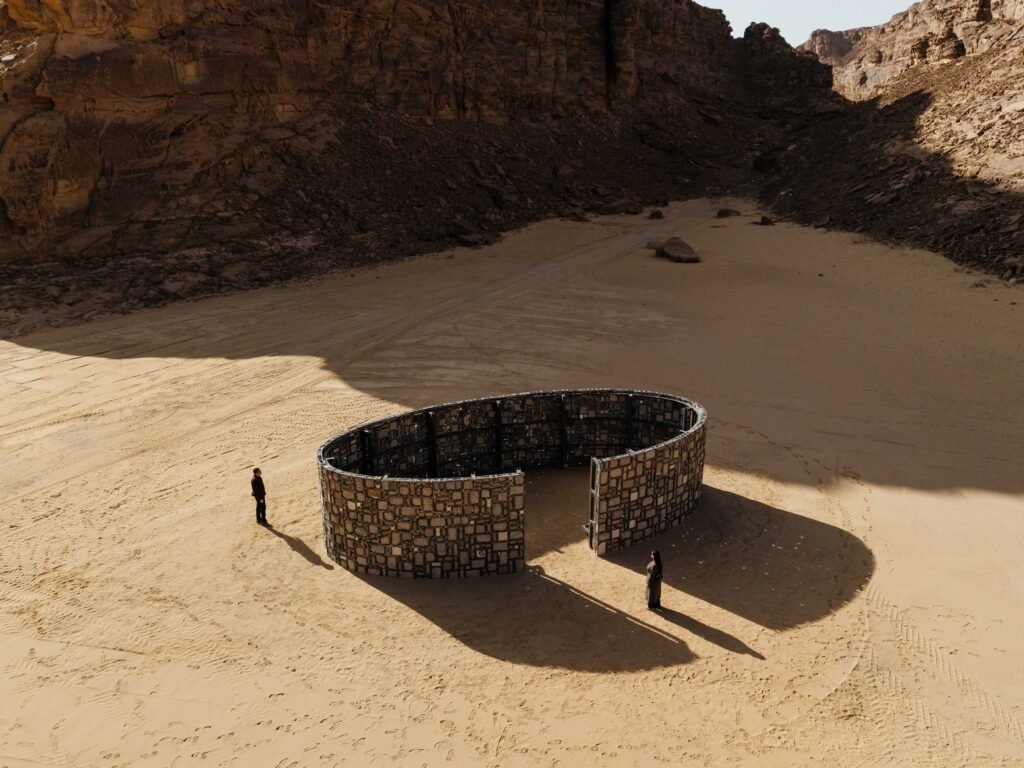
Only a few feet away, New Delhi-based artist Vibha Galhotra confronts environmental change and urban transformation in her art, Future Fables. She has taken the rubble and fragments from old buildings of AlUla, and encased them in a sophisticated steel framework. It’s a striking visual: the discarded past held up by the structure of the future. For Vibha, these materials stand as a witness to construction, collapse, climate anxieties, conflict, and desire. It’s a place to sit, reflect, and wonder what stories we will leave behind for those who walk these valleys a century from now. She expresses, “Embedded in each fragment is a history of water, labor and aspiration.”
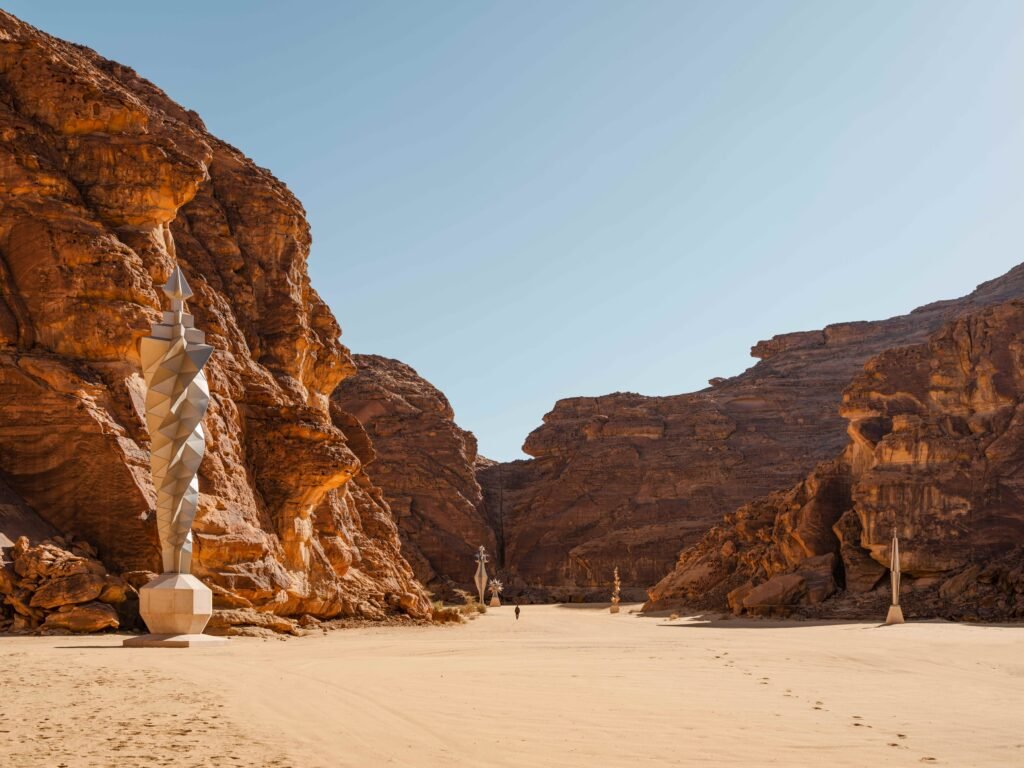
The most compelling displays are the never-before-seen works by Saudi modernist legend Mohammed AlSaleem (1939–1997). His bold geometric forms and color resonant the sharp lines of surrounding cliffs and the shifting tones of desert light. Temporarily on loan from the Riyadh Art collection, these works, born in the 1980s, look like they were pulled directly from the desert’s DNA.
The spikes of The Thorn symbolize protection and resilience, while the twisting facets of AlShuruf Unit reflect knowledge, understanding, and communication. The Triangles, rising through interlocking forms, represent the collective strength of diverse cultures. The unfurling petals of Flower Bud celebrate youthful potential and new beginnings, while the star and crescent motif crowning Al Ahilla draws inspiration from Bedouin tents and the vast desert night sky.
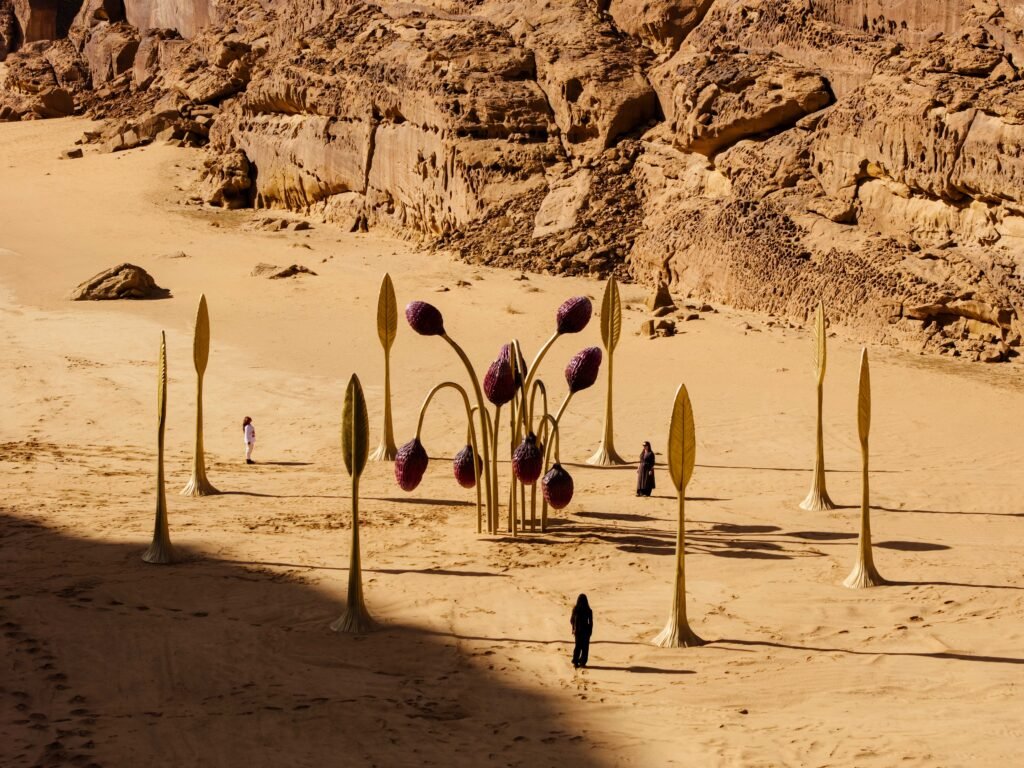
A few minutes away, Cuban-born artist Maria Magdalena Campos-Pons brings a burst of color to the desert with Imole Red. This “garden” of towering, red-hued sculptures is inspired by both Yoruba traditions and the intense colors of an AlUla sunset. The scale is intentionally overwhelming, making the visitor feel small, curious, and connected to a global history of migration and beauty.
Lebanese artist and composer Tarek Atoui treats the landscape as an acoustic laboratory. For The Water Song, he has created a series of “half-excavated” instruments that seem to be emerging from the desert floor. He experiments with the beautiful soundtrack of elements like bronze, water, glass, and stone. It’s a reminder that beneath the dry sand, there is a history of flow and life that still hums if you’re quiet enough to hear it.
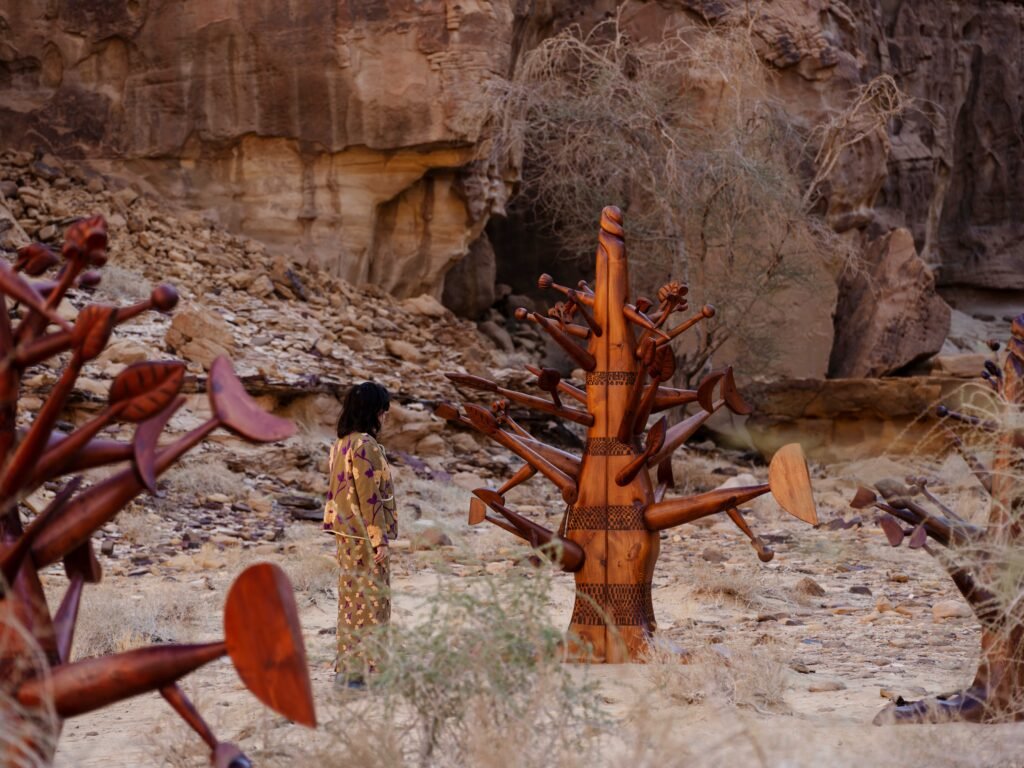
Across from it, Sudanese Modernist Ibrahim El-Salahi contributes a “forest” of carved wooden forms. This installation, called Haraza Tree, part of his ‘meditation trees’ series, is inspired by the Haraza Acacia from the banks of the Nile but also symbolizes the Acacia present in AlUla’s canyons. Painted in earthy tones of black, brown, and red, they stand as silent sentinels, inviting us to pause and contemplate the stoic endurance required to survive and thrive in the desert.
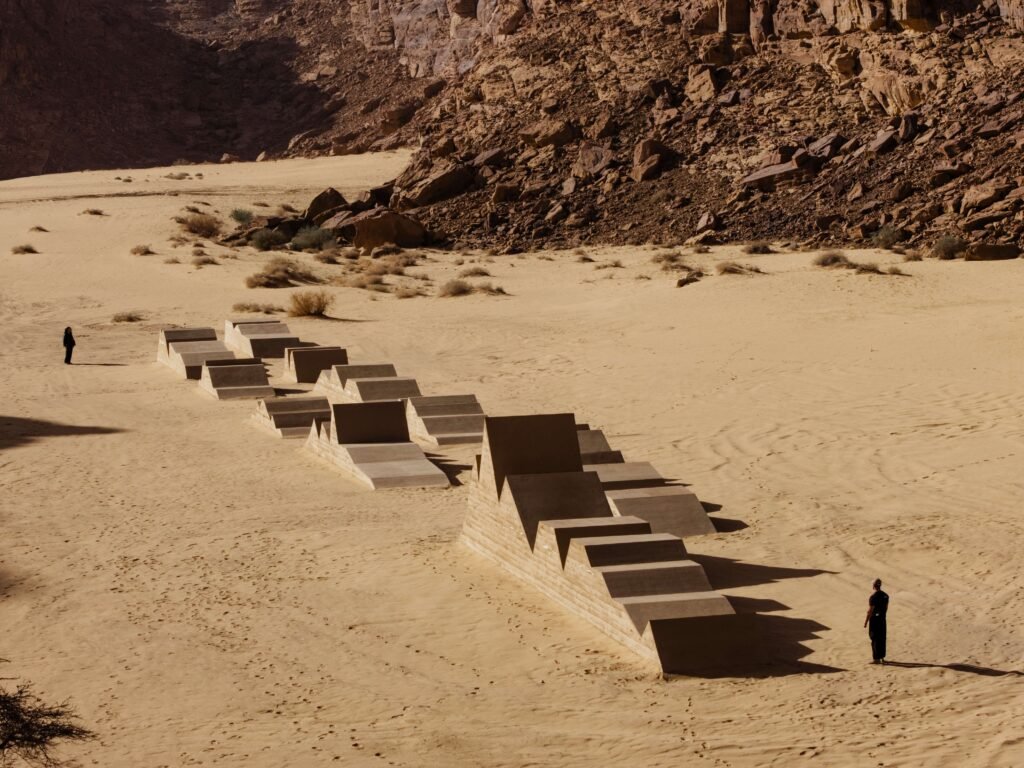
Saudi artist Sara Abdu has found a way to make the invisible, visible. Her work, A Kingdom Where No One Dies, features rammed-earth walls that look like natural rock formations. However, the ridges and peaks of these walls are actually modeled after the sound waves of her own voice reciting poetry. It is a hauntingly beautiful concept: a literal “echo” frozen in earth, allowing us to walk through the physical shape of a spoken word. Her poem concludes: Now breathe, you are in the Kingdom, where no one dies.
The Bahraini-Danish (Batool Alshaikh, Maitham Almubarak, and Christian Vennerstrøm Jensen) explores the most fundamental desert element: the sun. Their kinetic installation, Bloom, features spinning forms that interact with the harsh sunlight to cast ever-changing shadows across the terrain, focusing on plants that somehow thrive under the harshest of conditions. We engaged directly with the art by spinning its wheels and fell in love with the orbital dance of the cosmos.
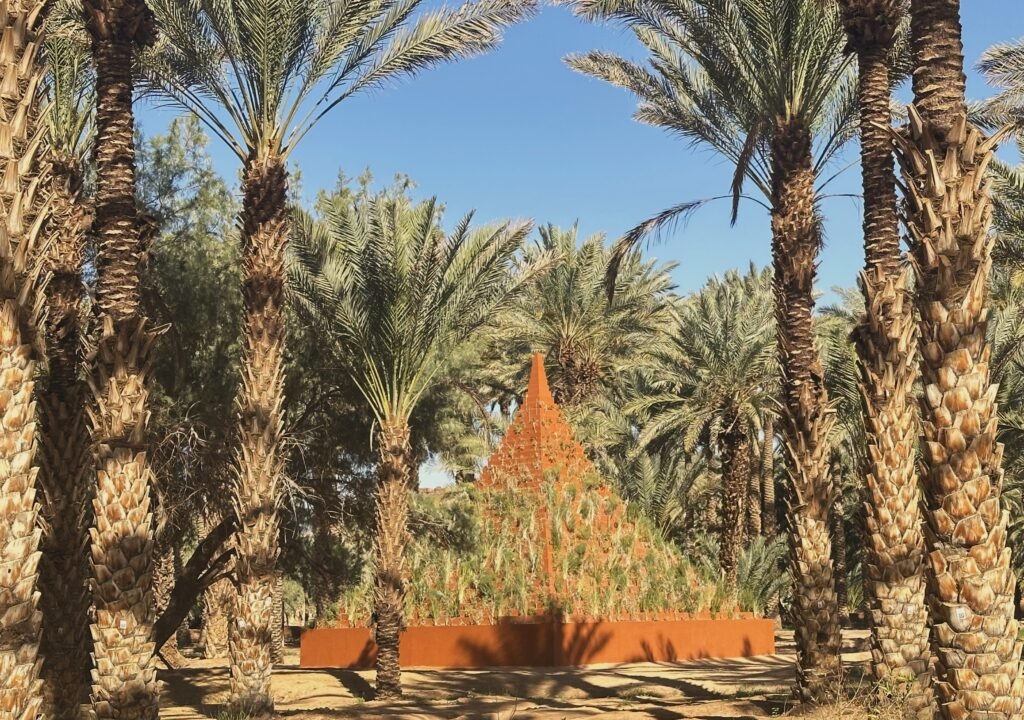
A true pioneer of land art, the Hungarian-born Agnes Denes brings a living soul to the exhibition. Her work, The Living Pyramid, is a 30-foot-tall monumental structure currently located within AlUla’s lush oasis. Previously displayed in many countries, including London, Germany, California, and Luxembourg. This time, it is sown with local flora such as rosemary, verbena, and wild grasses, and the pyramid will evolve throughout the exhibition. It is a testament to the resilience of life, moving from seed to blossom, and reminding us that beauty is a cycle, not a static state.
Hamad Alhomiedan, Director of Arts & Creative Industries at the Royal Commission for AlUla (RCU), assured, “At Desert X AlUla 2026, audiences will encounter an extraordinary diversity of artists whose works converse deeply with the land.”
As Wejdan Reda greeted, “We invite visitors to discover the land through fresh perspectives and moments of reflection shaped by its light and history.”
These inspiring artists continue to redefine how art can exist in dialogue with nature, history, and community.
Desert X AlUla 2026 is a reminder that when we remove the walls of a gallery, we also remove the limits on our own perspective.
Here, you don’t just view the art. You live it, you breathe it, and for a fleeting moment, you become a part of its measureless history.



Leave a Reply