
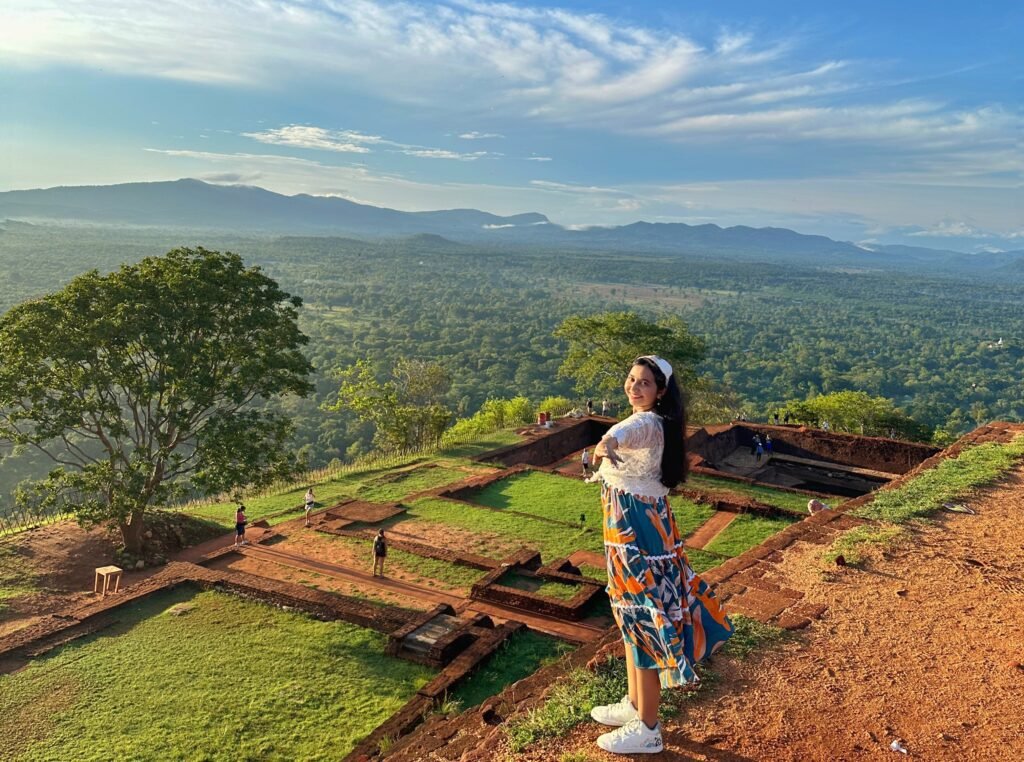
Sri Lanka is famous for its beautiful beaches, ancient temples, wildlife safaris, and landscapes that seem to change around every corner. But if there is one experience I would recommend adding to your Sri Lanka itinerary, it is climbing the iconic Sigiriya Rock. Yes, it will test your stamina but also reward you with some unbelievable views.
Our day began at 4 am. Yes, 4 am! We had barely managed to get enough sleep, and waking up at that hour was not exactly everyone’s idea of a relaxing holiday. But there was a sunrise to catch and a famous rock fortress to climb. Surprisingly, despite the lack of sleep, everyone was in good spirits so with an infectious positive energy; we were all ready to get going.
We reached the archaeological grounds while it was still twilight, scanned the tickets, and walked through the world-renowned Sigiriya Water Gardens. Spread across the base, these gardens feature symmetrical pathways, landscaped lawns, ancient pools, and clever underground hydraulics that still feed fountain jets when it rains. It is quite impressive to see the centuries-old advanced engineering and landscape design.
After admiring the garden, we started climbing the first slope. Already, stopping every now and then to catch our breath, admire the lush greenery and, of course, take a few photographs. A few minutes into the walk, my calves had already started aching. I looked at our guide, Prasad, hoping for a little encouragement. He turned around with a knowing grin. “Save your energy,” he chuckled. “The main steps haven’t even started yet.”
He wasn’t joking.
The History, Legend, and Significance of Sigiriya
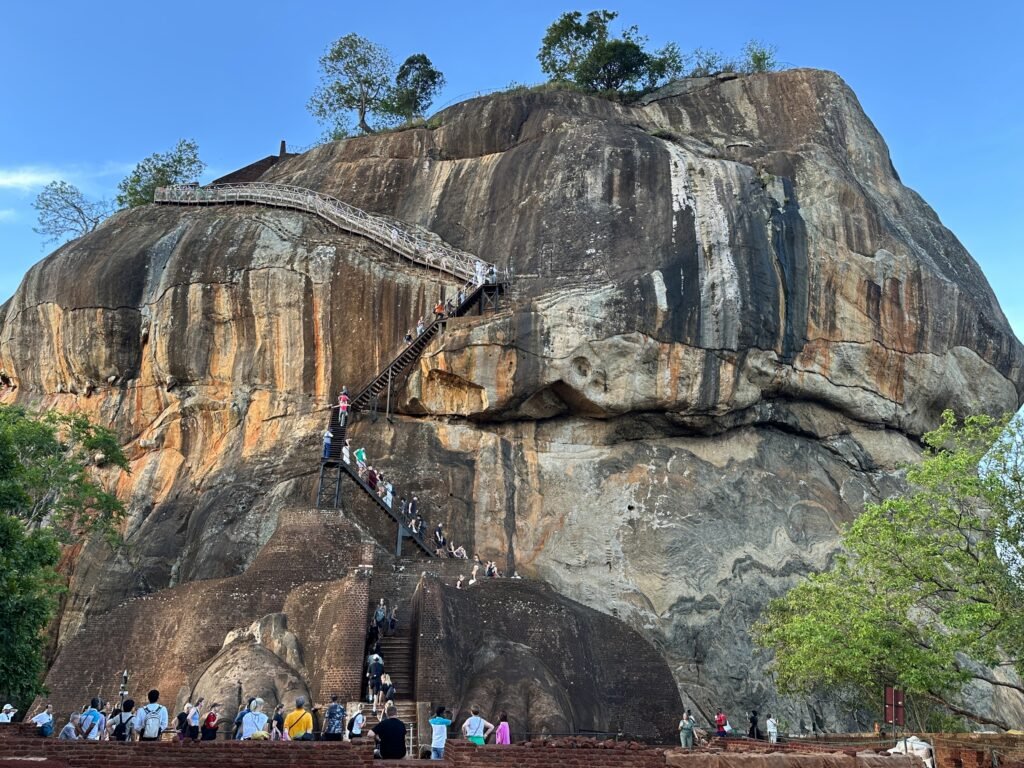
As we paused after the first ascent, Prasad shared the fascinating story of this UNESCO World Heritage Site. Located in Sri Lanka’s Cultural Triangle, near Dambulla, Sigiriya Rock Fortress is one of the country’s most renowned historical landmarks. Also known as Lion Rock, this enormous rock formation rises approximately 180 metres above the surrounding landscape.
The history of Sigiriya is associated with King Kashyapa I, who ruled Sri Lanka between 477 and 495 AD. According to historical accounts, Kashyapa seized the throne after killing his father, King Dhatusena. Fearing that his half-brother, Moggallana, the rightful heir to the throne, would return to claim power, Kashyapa moved his capital from Anuradhapura to the massive, impenetrable rock of Sigiriya and began transforming it into a royal residence and a heavily fortified kingdom. Within a relatively short period, the rock and its surrounding landscape were developed into an extraordinary complex featuring palaces, gardens, water systems, moats, and defensive structures.
In 495 AD, Moggallana returned with an army. During the battle, Kasyapa’s war elephant made a strategic movement that his troops mistook for a retreat. Left isolated, King Kasyapa took his own life with his own sword. Later, the site was used as a Buddhist monastery for several centuries before gradually being abandoned. Today, its remains offer a fascinating glimpse into Sri Lanka’s history and the remarkable skills of the people who built it and is one of the best-preserved examples of ancient urban planning in Asia.
The Lion’s Gate
One of the most fascinating parts of Sigiriya is the Lion’s Paw (Sinhagiri), which you encounter during the climb. The original gateway was designed in the shape of a gigantic lion. Visitors would have entered through the lion’s mouth before making their way up towards the royal palace at the summit (symbolizing that anyone ascending to see the king was entering the belly of the beast). Today, only two giant, intricately carved stone paws remain, but they are more than enough to convey the sheer scale of the craftsmanship.
Standing between the paws, I couldn’t help but imagine walking through the enormous entrance more than 1,500 years ago. How regal and skillfully designed to make the kingdom appear powerful and almost impossible to conquer.
The Frescoes and the Famous Mirror Wall
Another highlight of Sigiriya is its collection of ancient paintings, popularly known as the Sigiriya Frescoes. Located in a sheltered area along the rock face, these colourful paintings depict female figures adorned with jewellery and elaborate clothing. Their exact identities remain a fiercely debated mystery among historians. Some say that they represent celestial maidens or apsaras, while others associate them with members of the royal court.
Nearby is another fascinating feature called the Mirror Wall. Originally covered with highly polished plaster, the wall was designed to reflect the image of anyone walking alongside it. Over the centuries, visitors began leaving poems and inscriptions on its surface. Some of these writings date back many centuries, offering a rare glimpse into the thoughts and experiences of people who visited Sigiriya centuries ago!
Sigiriya and Its Connection to the Ramayana
Beyond its 5th-century historical records, Sigiriya holds a prominent place in local folklore. In fact, many connect the site to the ancient Indian epic, the Ramayana.
According to local legends, Sigiriya is believed to be Alakamanda, the mythic city of gods built by Kubera (the god of wealth) and later occupied by King Ravana. Local tradition suggests that the plateau served as one of Ravana’s majestic palaces with a Vimana (flying chariot) helipad, advanced underground lifts, and secret caves, one of which was where Sita was briefly hidden. These associations have made Sigiriya particularly interesting for Indians who enjoy exploring Lord Rama’s connections with Sri Lanka.
While archaeological records focus primarily on King Kasyapa’s construction, the deep-rooted association with the Ramayana adds an extra layer of mystery and cultural magic to the rock.
The Climb to the Summit
After learning about the history, it was time to tackle the staircase leading towards the summit. And yes, it is a lot of stairs!
Sigiriya has over 1,200 steps, and while the modern iron staircase hugs the sheer vertical cliff face, the handrails and protective mesh tubes make the climb a lot smoother and safer. We continued at our own pace, stopping whenever we needed a break. The best part is definitely admiring the expanding horizon right below us. The higher we went, the more beautiful these panoramic views became.
Just before we reached the highest point of the ruins, the clouds parted slightly to reveal a brief, stunning sunrise. The sun poured golden light across the jungle canopy. And that is when I let out a sigh and thought, “Yes, this was absolutely worth waking up at 4 AM for.”
What Awaits You at the Top of Sigiriya Rock?
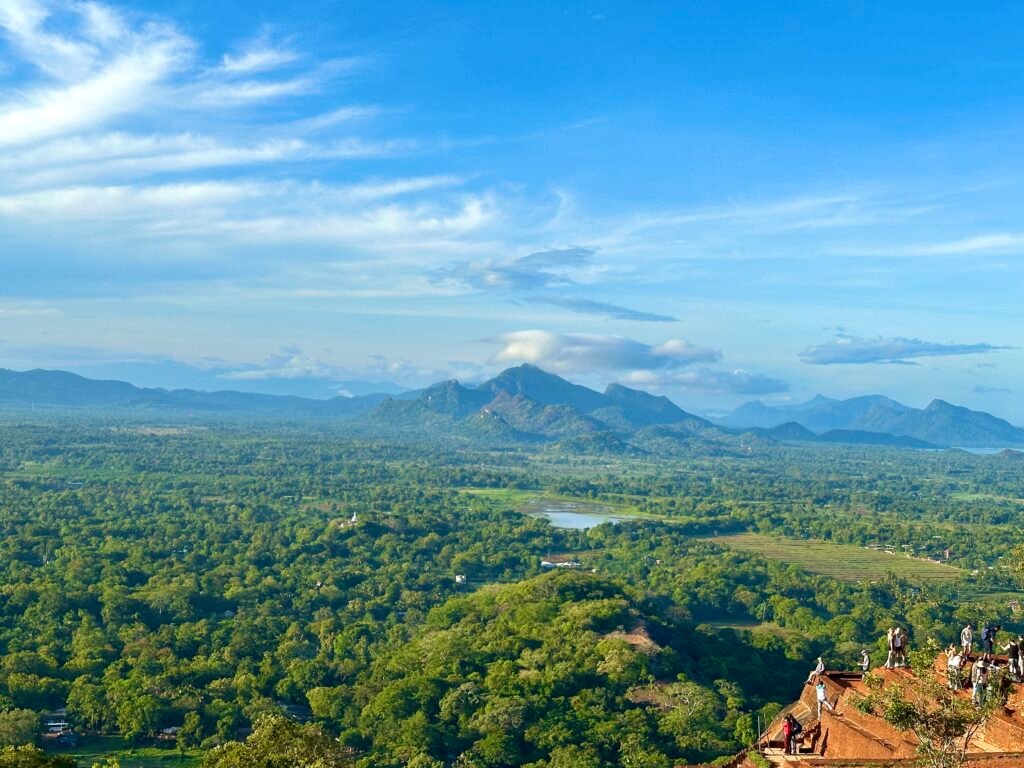
Eventually, after too many steps, super exhausted calves, and several much-needed pauses, we reached the summit. But before I could take in the sight, I sat down on the ancient rocks, trying to get my breathing back to normal, while my legs silently screamed at me for their torment. Finally, I stood up and looked around… my eyes widened in sheer awe.
All those steps, the early morning wake-up call, and the complaining calves suddenly seemed like a very small price to pay.
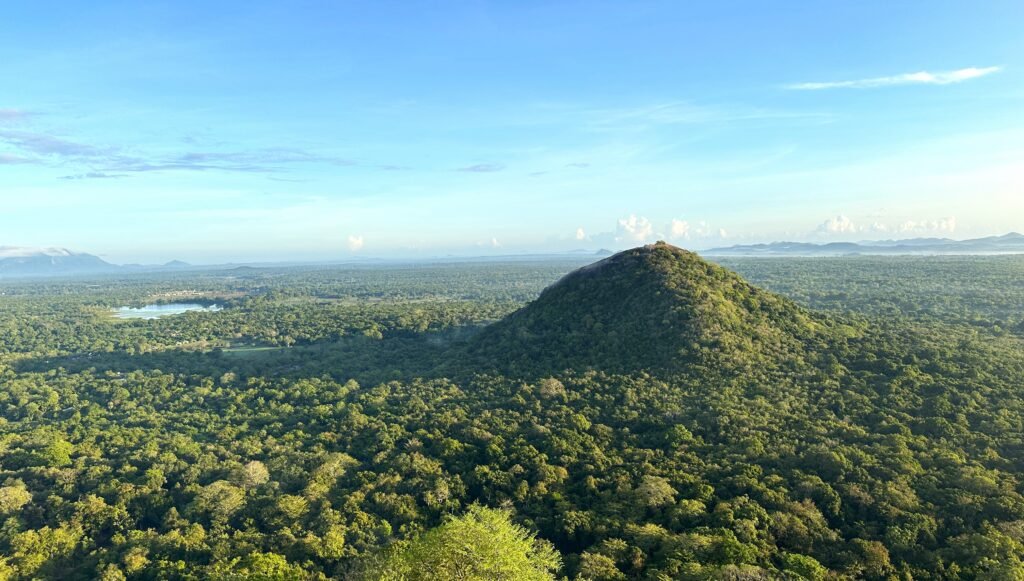
Because right in front of me was a 360-degree expanse of emerald forests, scattered lakes, small villages, and the distant Knuckles Mountain Range stretching as far as the eye can see. I could clearly see Pidurangala Rock, the neighboring hill standing directly opposite the fortress. Seeing the enormous rock rising from the surrounding green landscape is quite a mesmerizing sight. Pidurangala is another popular attraction in the area, particularly among travellers looking for a beautiful view of Sigiriya itself.
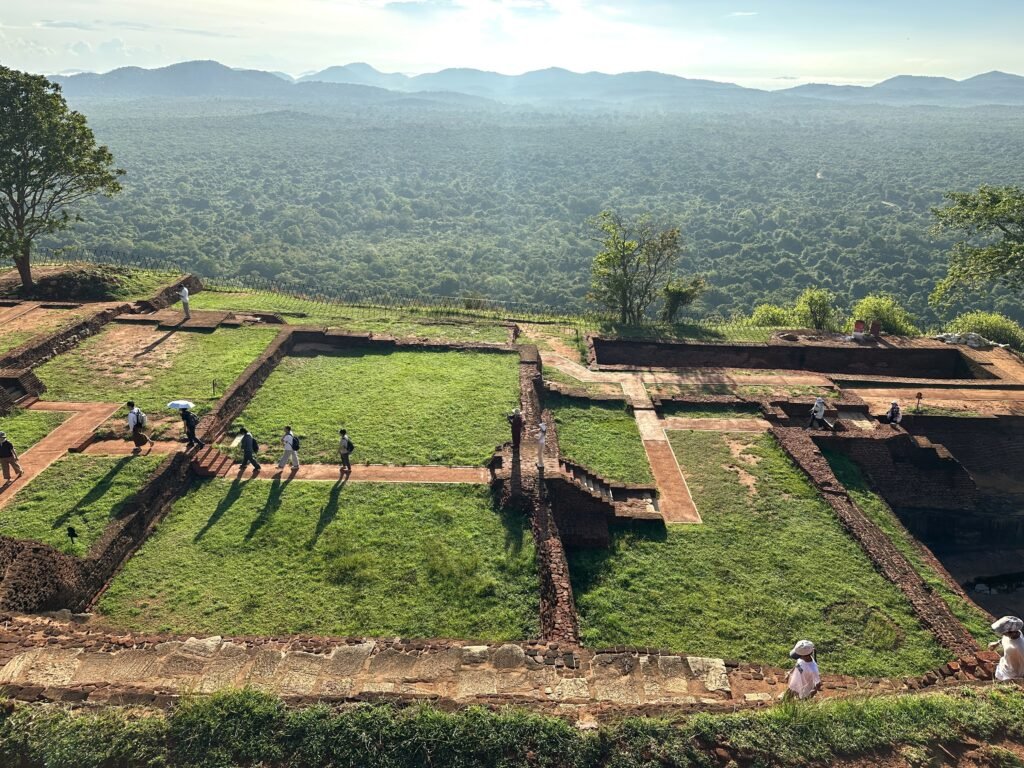
At the summit, you can also explore the remains of King Kashyapa’s ancient palace complex. Although much of the original structure has disappeared, you can still see the foundations, water cisterns, and traces of the royal buildings that once occupied the top of the rock.
Just take a minute to think about it – you are not simply climbing a rock for a photograph. You are standing exactly where a King once stood, actually tracing your fingers along ancient architecture, looking down at the very landscape that was once a Kingdom. Every staircase and every wall probably has a fascinating story to tell. And it is hard not to feel a little overwhelmed by the thought of how much history was witnessed here and how people managed to build something so extraordinary, so high above the ground, all those centuries ago.
So much has changed, yet Sigiriya still stands, holding on to fragments of a world we can only imagine. Between its rich royal history, intriguing Ramayana legends, and unmatched views across Sri Lanka’s central plains, I honestly think climbing Sigiriya is an absolute bucket-list experience.
Read More: Travelogue








Leave a Reply