
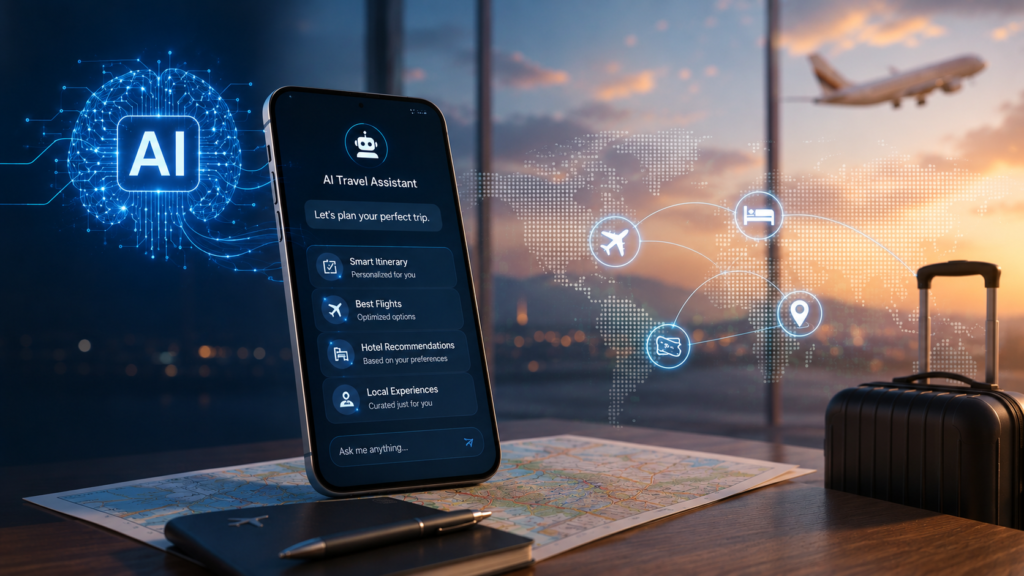
Travel has always been about discovery, but the way we plan and experience it is changing fast. Artificial intelligence is stepping in at every stage. Instead of jumping between multiple tabs, reviews, and maps, people are now turning to AI tools that can understand what they want, what they need, and build an entire plan around it.
Across the industry, airlines, hotels, and booking platforms are all using AI to better understand traveler preferences, predict needs, and offer more relevant choices. At the same time, the role of human connection hasn’t disappeared. If anything, it’s becoming more important in moments that require trust, emotion, and nuance.
But AI is certainly stripping away the logistical headaches that usually get in the way.
To understand this exponential shift, we spoke to founders, CEOs, and teams building these tools, applications, and digital assistants. We explore how and why platforms are evolving from simple chatbots into intuitive travel companions, whether AI is genuinely making travel smoother and more meaningful, and just how deeply AI is shaping the way we explore and experience the world.

Andy Moss, CEO of Mindtrip, has built a platform that goes beyond simple suggestions. Its standout feature, “Start Anywhere,” allows users to turn inspiration, whether it’s a photo, a PDF, or a social media screenshot, directly into fully mapped-out itineraries. Designed as an “on-trip companion,” the app uses real-time location data and insights from thousands of local experts to recommend what to do next… while you’re actually traveling. It also offers collaborative planning and shared editing tools, allowing friends or family to coordinate plans together within the app.
Q: How do you see traveler behavior changing because of AI? Are people becoming more spontaneous, more experimental, or more dependent on technology?
A: AI is shifting traveler behavior from searching to deciding. People can describe the kind of trip they want in open-ended, natural ways and instantly see options that balance budget, timing, preferences, and tradeoffs, opening up possibilities they wouldn’t have considered before.
At the same time, AI is making travel planning feel less overwhelming and more intuitive, helping travelers focus more on the experience itself rather than worrying about the logistics behind it.
Q: Do you see Mindtrip as a tool that can actively combat overtourism by intelligently redistributing travelers to under-visited gems?
A: Overtourism is, at its core, a discovery problem. Travelers tend to gravitate toward what they already know or what’s easiest to find. Mindtrip helps to change that. When you understand the traveler and the context of their trip, you can surface equally compelling alternatives that fit their preferences, not just the most popular destinations. This helps travelers move beyond overcrowded hotspots and bring more attention to places that are often overlooked.
Edward Byrne, CEO of Powder Byrne, recently launched Perfect Piste, a first-of-its-kind luxury AI ski travel platform designed to make mountain getaways effortless. This trailblazing tool uses intelligent algorithms to match skiers with their ideal alpine experiences based on highly specific personal preferences. Beyond the booking stage, the platform acts as a digital companion, providing real-time, up-to-date advice to ensure every run and resort stay is perfect.

Q: For someone planning their first ski trip, how does your platform make the experience less intimidating and more accessible and reassuring?
A: At Perfect Piste, we are focused on removing the uncertainty that often makes a first ski trip feel overwhelming. Skiing has a steep learning curve, not just on the slopes but in the planning. Choosing the right resort for potentially multiple people, understanding the terrain, booking lessons, sorting equipment, and navigating logistics can quickly become daunting.
Our AI acts like a highly knowledgeable, always available, and personal ski concierge. It takes a user’s ability level, preferences, budget, and travel constraints and transforms it into clear and personal recommendations with access to exclusive stays. For a beginner, that might mean steering them toward a resort with excellent ski schools, gentle slopes, and easy-to-navigate layouts, while also explaining why those choices are right for them.
We also simplify the fragmented planning process by bringing everything into one place, from accommodation to ski expertise and supplier information, so users are not juggling with multiple websites or second-guessing decisions.
The result is a more guided, confidence-building experience that helps first-time skiers feel prepared rather than intimidated.
Q: How does Perfect Piste adapt to unpredictable factors like changing snow conditions, weather patterns, or last-minute travel disruptions?
A: Perfect Piste is a platform built to be inherently dynamic rather than static. Our AI continuously ingests and interprets real-time and historical datasets and recommendations from resort personalities that are not available anywhere else – so not just snow forecasts, weather, and resort operational information, but deeper local insights. We designed it this way to optimise recommendations based on all the likely conditions at the time of travel and help users navigate.
This allows us to move beyond generic suggestions and instead surface options with the highest probability of delivering a good experience. As conditions evolve, the system can rapidly re-rank destinations or suggest intelligent alternatives, helping travellers stay one step ahead of disruption.
The result is a more resilient, data-driven approach to skiing, where plans are not fixed but continuously optimised.

For Shir Ibgui, Founder and CEO of Globe Thrivers, the key to the future is bridging the gap between digital efficiency and human authenticity. Her platform utilizes AI to transform inspiring social media content into actionable, creator-led itineraries that prioritize community-driven authenticity and recommendations that make travel planning easier, faster, and more enjoyable.
Q: Where do you think AI adds the most value in the travel journey right now?
A: The biggest impact of AI in travel is where it meets real, human experience. Travel is very personal, people always want something that feels true to them. AI is great at handling the heavy work. It can organise trips, plan routes, save time, and suggest options quickly. But it doesn’t have personal taste or real-life experience. That’s where human input still matters.
The real shift is combining both. AI builds the structure, while real recommendations, like those from travellers or creators, add trust, context, and personality. Right now, this shows up in smarter itinerary tools that plan your travel better, real-time assistants that help during the trip, and platforms that turn inspiration from social media into actual, bookable plans.
Q: For young travellers, how has the trip planning process changed with the rise of AI tools?
A: Travelers are using AI in two main ways today.
The first is as a starting point. Many people use AI to create a rough itinerary, just to get a sense of where to go, how long to stay, and how to plan their days. But more often, the process works the other way around. Travelers first get inspired through friends, social media, or creators. They save posts, videos, and recommendations, and then turn to AI to organise all of that into a travel plan.
In both cases, AI is more of a tool that helps organise and simplify information. People still rely on reviews, social platforms, and trusted sources to validate their choices before booking.
This is exactly what we’ve built at Globe Thrivers, the platform helps people turn scattered ideas from platforms like TikTok or Instagram into personalised itineraries that make every trip memorable.
Bridging the gap between travel inspiration and actual logistics is Sahil Sharma, Cofounder and CEO of Rimigo. At its core, Rimigo replaces the clutter of traditional itineraries with “Tripboards”—a visual, highly collaborative way to organize every detail of a journey in one place. It is a platform designed for the modern traveler who values their time as much as the “vibe” of their next adventure.

Q: How deeply does Rimigo personalise a trip, beyond basic preferences like budget and location?
A: Most travel platforms ask you a few questions at the start and call it personalisation. Rimigo works differently, it functions as your travel system of record, building context about you continuously rather than starting from scratch every time you plan a trip.
Over time, Rimigo learns things that most platforms never ask: who you typically travel with, whether anyone in your group has dietary restrictions or allergies, whether a trip is for business or leisure, how hectic you like your travel days, and whether you prefer slipping into the rhythm of a city on public transport or moving on your own terms with private transfers. It also holds the details that sit in your head rent-free — your anniversary date, flight times, and other commitments that a good itinerary needs to actually respect.
As that context deepens, so does the quality of what Rimigo recommends. A returning user doesn’t get a generic itinerary, they get one shaped by everything they’ve already shared. Personalisation at Rimigo isn’t a feature; it’s the compounding effect of your context being kept in one place and used intelligently every time.
Q: How does Rimigo navigate the volatile world of real-time travel pricing to ensure users actually get the deal they see?
A: Pricing in travel is notoriously unstable — a fare that exists at 9 am may not exist at 9:05 am. Rimigo addresses this through two parallel tracks that together give travellers both breadth of options and confidence in what they see.
The first is third-party integrations. Rimigo connects via APIs to the most widely used travel platforms, pulling live prices and availability in real time. There’s no cached or indicative pricing — when you see a number on Rimigo, it reflects what’s actually available at that moment across those platforms. The second is Rimigo’s own supply. Through direct B2B partnerships and DMC integrations, Rimigo has negotiated access to inventory outside the standard OTA ecosystem. These Rimigo-priced options come with real-time pricing and availability feeds as well, but with the added advantage of rates that aren’t subject to the same demand-driven volatility that public platforms experience.
The result is that every Tripboard surfaces two types of prices — third-party rates and Rimigo rates — giving travellers a genuine comparison and, in many cases, access to deals they simply wouldn’t find by searching on their own.
Analyzing the rapid evolution of digital discovery is Andra Izgarian, Founder of Zanobe, a digital marketing agency operating exclusively across Southeast Asia, Portugal, and the UK. Over the past 18 months, Zanobe has carved out a unique space in the hospitality sector by developing and deploying AI visibility audits for hotels. The team looks directly at the live data to see exactly how search engines and generative models are altering consumer behavior.

Q: What kind of hotel content performs best when AI tools recommend properties to travelers- reviews, social media, structured data, visuals, or something else?
A: Absolutely structured data wins, by far. AI tools don’t read a website the way a human does, but rather they pull from machine-readable signals: schema markup, Google Business Profile completeness, consistent NAP data (name, address, phone) across every platform, and factual attribute listings like room dimensions, amenity lists, and verified location data.
Reviews really matter; however, it scans for more than just “star ratings.” It looks for volume, recency, and how consistently a property is described across multiple credible sources. A hotel mentioned in 40 reviews, 3 press articles, and 2 travel directories will outperform a hotel with a perfect 5-star average and minimal digital footprint, every time.
Social media and visuals have almost zero direct influence on AI recommendations right now. They build brand awareness, but won’t get you cited.
The content that also really moves the needle is FAQ-structured website copy, high-authority press mentions, and third-party citations from travel platforms that AI models draw from. We call this GEO (Generative Engine Optimization), and it’s a fundamentally different discipline from traditional SEO.
Q: In your experience, what makes a hotel more “AI recommendable”? Are independent hotels more vulnerable to being overlooked compared to larger global hotel brands?
A: Yes, for sure. Global chains have three structural advantages that independent hotels simply don’t have yet. First, brand name recognition. ChatGPT and Gemini have seen Marriott and Hilton mentioned millions of times across their training data. An independent boutique in Lisbon or Koh Samui has a fraction of that digital footprint. Second, chain hotels have dedicated tech teams maintaining structured data at scale. Third, OTA presence. The major booking platforms are heavily indexed by AI, and chains dominate OTA search results, which feeds back into AI recommendations.
We audited a five-star independent resort in Southeast Asia recently. Strong reviews, real market positioning, genuine luxury product. It scored 47% AI visibility across ChatGPT, Gemini, Claude, and Perplexity, ranking fifth out of six competitors. One major platform didn’t recommend it at all. The property had no idea they were running at such a strong disadvantage. A report released by Cloudbeds compiled from 90 million real bookings showed independent hotels saw ADR fall 5.8% and RevPAR drop 5.4% in 2025, while branded hotels held steady. AI invisibility is part of that story.
There’s a really great window for independent hotels to move fast, but they need to do it soon!
The reality is that no algorithm can ever truly replicate the nervous excitement of stepping into a city you’ve never seen before. What it can do, however, is ensure that when you finally get there, your mind isn’t trying to remember which restaurant had the good reviews and whether the museum is closed on Mondays. This new wave of technology is there to help us wander more freely, enjoy conversations with strangers, and fall in love with a new place.
Let the technology handle the plans and work on strategies. The beautiful, bewildering, unforgettable thrill of experiencing a new place, that part is still entirely yours!






Leave a Reply