
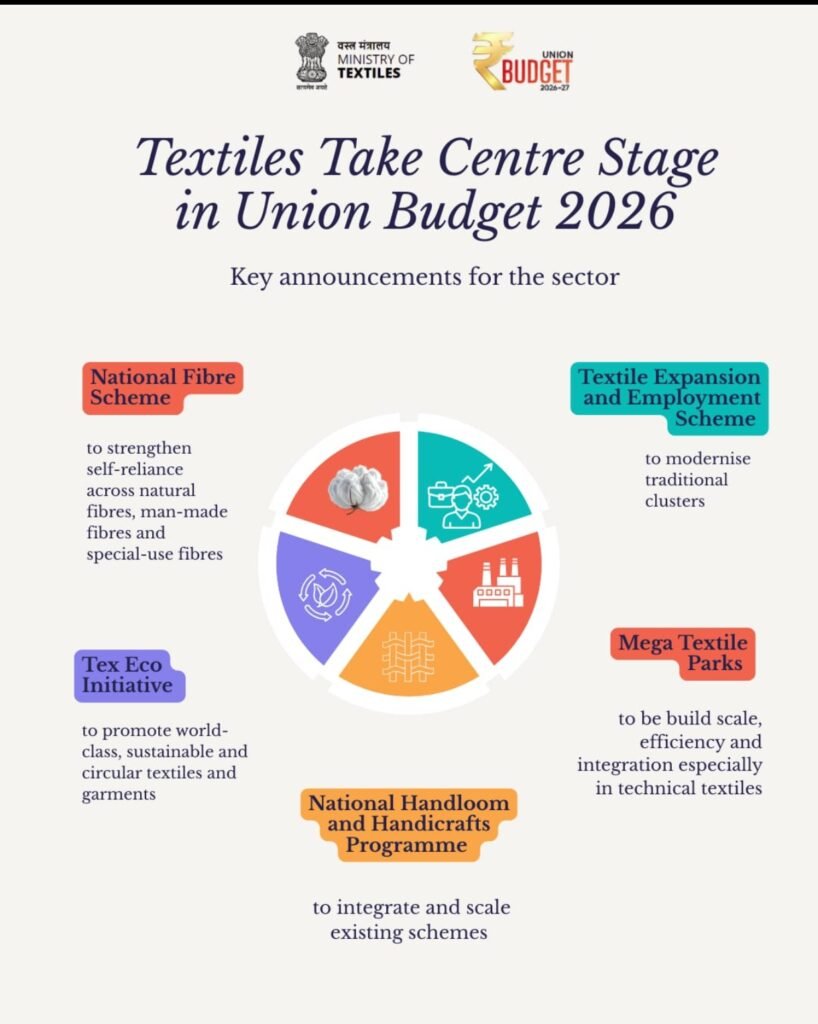
India’s textile and apparel sector stands as one of the country’s most vital economic engines—deeply interwoven with rural livelihoods, industrial growth, exports, and employment generation. With a presence across the entire value chain—from fibre and yarn to garments, technical textiles, and handicrafts—the sector reflects both scale and diversity. Budget 2026 recognises this strategic importance and presents a structured roadmap aimed at enhancing competitiveness, sustainability, value addition, and inclusive growth.
At the heart of the Budget is the Integrated Programme for the Textile Sector, an umbrella framework that seeks to align fibre development, manufacturing expansion, cluster modernisation, artisan support, sustainability, and skill development within a coordinated policy structure. This integrated approach is designed to reduce fragmentation, improve implementation efficiency, and deliver measurable outcomes across the textile ecosystem.
Mega Textile Parks: Driving Scale and Efficiency
A central feature of Budget 2026 is the continued push for Mega Textile Parks, implemented under a performance-oriented, challenge-mode framework. These parks are envisioned as world-class manufacturing ecosystems offering plug-and-play infrastructure, common processing facilities, quality testing laboratories, warehousing, and seamless logistics connectivity.
By clustering spinning, weaving, processing, garmenting, and technical textile manufacturing within a single integrated zone, these parks reduce transaction costs and improve operational efficiency. Enhanced connectivity to ports and industrial corridors strengthens export readiness, while the inclusion of sustainable infrastructure—such as common effluent treatment systems, water recycling facilities, and renewable energy integration—ensures compliance with international environmental standards.
Importantly, the renewed focus on technical textiles within these parks signals a strategic shift toward high-value segments with strong global demand and export potential.
Cluster Modernisation and MSME Support
India’s textile strength lies not only in large manufacturing hubs but also in its extensive network of traditional clusters and MSMEs. Recognising the need for technological upgradation, the Budget introduces the Textile Expansion and Employment Scheme, aimed at supporting capital investment in modern machinery, productivity enhancement, and quality improvement.
Complementing this is the Rejuvenation of Legacy Industrial Clusters Scheme, targeting nearly 200 established clusters for infrastructure strengthening and technological advancement. By establishing common testing and certification centres and improving shared facilities, these initiatives enhance cost competitiveness and global compliance standards.
Together, these measures reinforce MSMEs—the backbone of the textile value chain—while generating employment and strengthening regional production centres.
National Fibre Scheme: Building Raw Material Resilience
Long-term competitiveness depends heavily on stable and quality raw material availability. The newly introduced National Fibre Scheme addresses this critical need by promoting self-reliance across natural fibres such as silk, wool, and jute, while also encouraging development of man-made and new-age fibres.
The scheme supports research, innovation, and public–private partnerships to enhance domestic fibre production and reduce import dependence. By ensuring consistent quality fibre availability, particularly for MSMEs, the initiative strengthens supply chain resilience and stabilises input costs. It also aligns with global expectations for traceability and responsible sourcing.
Tex Eco Initiative: Mainstreaming Sustainability
Sustainability has moved from being a preference to a prerequisite in global trade. Responding to this shift, Budget 2026 introduces the Tex Eco Initiative, aimed at promoting environmentally responsible and globally competitive textile production.
The initiative encourages adoption of cleaner production technologies, efficient resource utilisation, waste reduction practices, and circular economy principles. As international buyers increasingly demand transparency and eco-certification, embedding sustainability into the manufacturing process enhances India’s credibility as a trusted sourcing destination.
Samarth 2.0: Strengthening the Skill Ecosystem
Skilled human resources remain central to industrial advancement. The upgraded Samarth 2.0 scheme modernises textile skill development through structured collaboration between industry and academic institutions.
The programme emphasises practical training on advanced machinery, digital systems, quality control, and workplace safety standards. Stronger apprenticeship models aim to improve industry absorption rates. With a focus on women, rural youth, and economically weaker sections, Samarth 2.0 reinforces inclusive growth while ensuring that the workforce is aligned with global manufacturing standards.
Empowering Rural and Traditional Segments
Budget 2026 also underscores the importance of decentralised growth. The Mahatma Gandhi Gram Swaraj Initiative (MGGSI) strengthens khadi, handloom, handicrafts, and village industries through branding support, quality enhancement, and improved market linkages.
In addition, the unified National Handloom and Handicraft Programme consolidate multiple support mechanisms to improve efficiency and targeted delivery. Support for design innovation, digital marketing, e-commerce integration, and participation in exhibitions ensures that artisans are better connected to domestic and global markets. These measures preserve traditional craftsmanship while transforming it into sustainable economic opportunity.
Expanding into High-Performance Segments
A noteworthy addition in Budget 2026 is the Dedicated Initiative for Sports Goods, which promotes manufacturing excellence, research and development, and innovation in materials and product design. With growing global demand for high-performance sports equipment, this initiative strengthens the linkage between textiles, advanced materials, and technical applications—opening new avenues for export growth.
A Structured Path Forward
Budget 2026 reflects a mature policy approach that moves beyond incremental measures toward structural transformation. By integrating fibre security, cluster modernisation, sustainability, skill development, rural empowerment, and innovation under a unified vision, the government has outlined a comprehensive growth framework.
The emphasis on technical textiles, environmental compliance, and value addition indicates a clear intent to position India not merely as a volume-driven exporter, but as a high-quality, globally aligned manufacturing hub.
With effective implementation and strong industry participation, the initiatives outlined in Budget 2026 have the potential to reinforce India’s position as a resilient, competitive, and sustainable textile powerhouse—driving exports, employment, and balanced regional development in the years ahead.
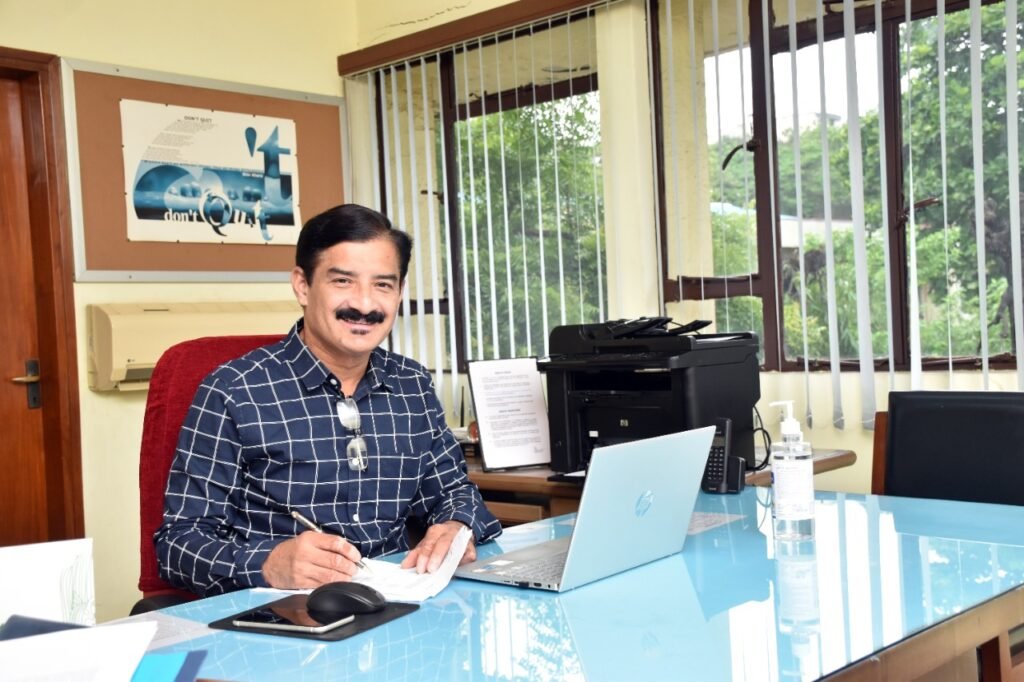
The author Dr. Sreekumar is currently the Director of The Bombay Textile Research Association, Mumbai with Ph.D. in Polymer and Fiber Science from IIT Delhi, India and post-doctoral training at Georgia Institute of Technology, Atlanta, USA. He has over 25 years of experience in senior management, technology strategy, research and development, teaching, testing and quality assurance in Academic, Chemical, Material and Textile Industry.
He worked as a research scientist at Georgia Tech, as Scientist E at DRDO, as VP at Reliance Industries He is a winner of Technology Day Titanium Medal and certificate from Scientific Advisor to Defence Minister. He is also the founder of Technorbial Advanced Materials Pvt Ltd.





Leave a Reply