

“I dream of a Digital India where cyber security becomes an integral part of our national security” – Indian Prime Minister Narendra Modi
Cyberspace connects us virtually with crores of online users across the globe. With increasing use of cyberspace, cybercrimes is a rapidly growing problem globally and India is no exception especially with cases increasing from 10.29 lakh in 2022 to 22.68 lakh in 2024. Over 9.42 lakh SIM cards and 2,63,348 IMEIs linked to cyber frauds have been blocked.
The most common cybercrime is financial fraud (including digital arrest, click scams, phishing) as well as online sexual exploitation, blackmail, fake KYC requests etc. In 2025 AI-powered attacks was leading. In India Karnataka had the highest number of cybercrime cases, followed by Telangana. The best part is that India’s Union Budget 2025-2026 has allocated ₹782 crore for cyber security projects.
Cyber Threats
Cyber frauds refer to deceptive activities carried out through digital platforms such as unauthorized access, data theft, or online scams, which are often intended to cause financial loss to victims.
Techniques like spoofing, where criminals act like trusted sources, are showing up in multiple fraud reports. Likewise, cases of deepfakes leveraging AI (Artificial Intelligence) and phishing, where individuals are lured into revealing sensitive information through deceptive emails or messages, are also on the rise.
Unified Payments Interface (UPI), India’s most preferred digital payment mode, has also been targeted by fraudsters using compromised mobile numbers. To address this issue, the Department of Telecommunications (DoT) launched the Financial Fraud Risk Indicator (FRI), which classifies suspicious numbers as Medium, High, or Very High-risk.
The Government of India has implemented strong defence mechanisms aimed at safeguarding its vast online community. Over 1,05,796 police officers are now registered on the CyTrain portal, with more than 82,704 certificates issued, equipping frontline personnel with essential cybercrime investigation skills.
Illicit digital ventures have also emerged in the form of online betting apps, luring users into depositing funds in their online wallet to play such games with fake promises of large returns, generating over ₹400 crores in criminal proceeds.
Strengthening India’s fight against cyber frauds, the Promotion and Regulation of Online Gaming Bill, 2025 was passed on 21st August 2025.
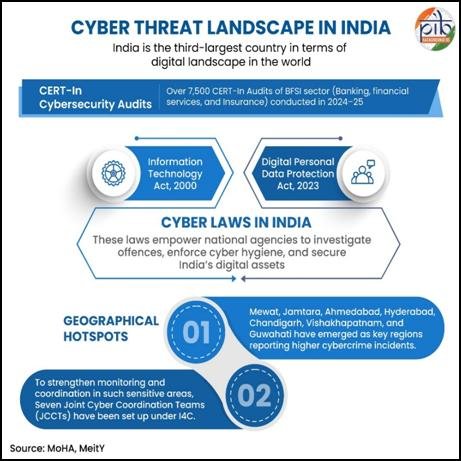
Indian Computer Emergency Response Team (CERT-In) is the national agency for responding to cybersecurity incidents. It monitors cyber threats, detect vulnerabilities, and issue necessary advisories. Upon identification of incidents such as data breaches, phishing campaigns, or malware intrusions, CERT-In disseminates alerts and prescribes remedial measures to affected organisations. This proactive mechanism ensures timely containment of risks and enhances resilience across government, industry, and critical service providers. As of March 2025, CERT-In facilitated 109 cybersecurity mock drills, engaging 1,438 organizations from different states and sectors to assess cyber readiness and build resilience.
To strengthen preparedness against cyber-attacks and cyber-terrorism, the Government has initiated CCMP for all government bodies. The plan serves as a strategic framework to ensure coordinated recovery from any cyber crisis. So far, 205 workshops have been conducted across the country to build capacity and awareness under this framework.
Cybercrime Volunteers in India
People keen on contributing to a safer digital environment, keen to make the internet a cleaner and safer place by assisting in the fight against cybercrime, he can opt to become a cybercrime volunteer.
Indian Cyber Crime Coordination Centre (I4C) has been established under Ministry of Home affairs (MHA) to act as a nodal point at National level in the fight against cybercrime. It aims to provide a platform to deal with cybercrimes in a coordinated and comprehensive manner. One of the important objectives of I4C is to create ecosystem that brings together academia, industry, public and government in prevention, detection, investigation and prosecution of cybercrimes.
I4C has envisaged the Cyber Crime Volunteers Program to bring together citizens with passion to serve the nation on a single platform and contribute in fight against cybercrime in the country.
Citizens can report cybercrimes using the national helpline at 1930 or through the National Cyber Crime Reporting Portal at cybercrime.gov.in.








Leave a Reply